
Death is remembering

Across mystical traditions, death is understood as a return, not an end. The process of dying catalyses a movement from our limited states back into the eternal.
Death is a process of remembering and forgetting. When we pass away, everything that is not eternal loses its grip and we return to source.
From this perspective, being born was a kind of death; a contraction of eternity into time, a period of seventy to one hundred years in which eternity appeared to forget itself by entering into a body with limbs and into an ego with a personal identity.
Why did God impose this limitation on itself?
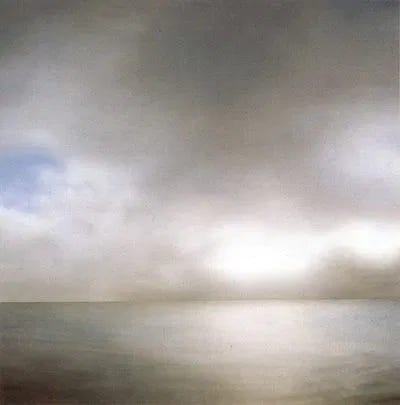
Pure, infinite being has no edges, no inside or outside, no subject and object. In this giant ocean of consciousness with no coastlines, there is nothing to look at, nothing to compare or reflect against.
So the divine opened a limitation within itself – us, the universe – creating a vantage point from which to perceive and experience itself. The ‘creation story’ in religious texts might also be understood as a ‘limitation story’.
God, or divine consciousness, preparing for this moment of limitation creation is described in Genesis 1:2:
Now the earth was formless and empty, darkness was over the surface of the deep, and the Spirit of God was hovering over the waters.
This is the stage setting before the footlights explode and the actors appear. Then, a series of limitations and separations is imposed.
Let there be light (Genesis 1:3)
Light creates distinction with darkness, and the precondition for seeing. After introducing creatures, man is brought on in ‘God’s image’.
Then God said, “Let us make mankind in our image, in our likeness” (Genesis 1:26).
And so, conscious reflection appears. Humans are introduced as God’s mirrors, reflecting back his image, creating vantage points from which God can experience itself in a finite form. God sits in the auditorium, like an adoring parent watching the drama of creation unfold.
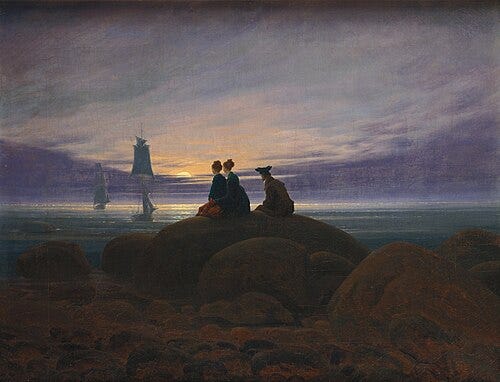
What is frightening about death from our limited, egoic perspective is the return to unknowing. Through our separated ego identity, God sees itself from a particular perspective; but when that identity dissolves, the ego-based way of seeing disappears, giving way to a return to pure awareness.
This is why death can be such a traumatic prospect, especially in an overly ego-identified culture like our own, where our worldly sense of self is everything to us. When we believe we are the ego, death feels like a total end.
But death is not annihilation. Death is a process of remembering our true nature. And perhaps, after returning to the primordial soup of consciousness, this process happens again and again. The universe is thus revealed as a magnificent churning of souls.
I hope you enjoyed this piece. If it resonated, please share it with someone who might like it too. Thank you to everyone who reads, likes, comments, subscribes, and supports my work, it truly means a lot. I always appreciate hearing from you in the comments and by email.
And what is our true nature after the ego is gone? Is the soul then untethered and free?
This is consoling to me, having lost my mother. I wonder what God thinks of the reflections that we are…