
How to read the Odyssey

The best way of retaining and understanding the things we read is to write about them. The books I know the best are the ones I wrote essays about at university. Essay writing is a form of active learning that completely alters how you go about reading and understanding great works of literature. If you do it from memory, without referring to the original text or your notes, you feel the mental mechanisms moving, a sign that real personalised learning is taking place.
You read something, you jot down what you remember without looking back at the book. It’s usually the simplest things that bubble up to the surface. But for whatever reason, they are the things that stuck, which means it also hyper-personalises the reading process. You retain what most resonated with you.
The habit is shockingly revealing; one, for highlighting the kinds of things that stick, and two, for highlighting just how little you remember sometimes. This morning, for instance, I was reading a biography of the French writer Balzac by Graham Robb. I was distracted and unfocused for much of the time. If I sit here and consider what I actually remember, after thirty minutes’ reading, it amounts to something pitiful.
Balzac engaged in celibacy and non-ejaculation to retain his ‘vital fluid’ for creative purposes.
For obvious reasons, that one’s pretty memorable.
Balzac dreamt of writing a 300-page novel set entirely on the battlefield, a narrative that ‘began with cannon fire and ended with a cry of victory’. The work was never completed, and barely begun in fact. It amounts to about half a sentence.
What else can I recall… Basically, that’s it. So, on paper at least, not a very enlightening session. That’s another reason to start essaying about the books we read – because it heightens the reading process itself. As you read, the mind focuses in because unconsciously it knows it must connect with the text in order to write about it later.
I’ve been slowly going through Homer’s The Odyssey every day. My knowledge of Greek texts is woeful, and what with the upcoming rendition by Christopher Nolan, I thought it best to dive in. I’m going through line by line and looking up all the characters and turns of phrase. Some of the names appear with unfocused familiarity, as if emerging from a dense fog. Achilles, ah yes, he’s the one with the weak ankles played by Brad Pitt. Zeus, the most powerful Greek god. Mount Olympus, the spot where the gods meet and debate interventions and punishments for the material world. Poseidon, that’s the furious sea god.
Homer writes with the assumption that the reader knows all about the conflicts taking place at the time, the history of conflicts, characters, and the godly forces at play, along with critical cultural elements like xenia (guest-friendship), which was a sacred moral obligation at the time and ties crucially into the story dynamics.
I’ll apply the ‘essay to understand’ technique to my Odyssey reading so far. I needed to research all the most basic background information for context, so this and future essays will serve as good introductions to the work. Some of this information is taken from my notes whilst reading the book.
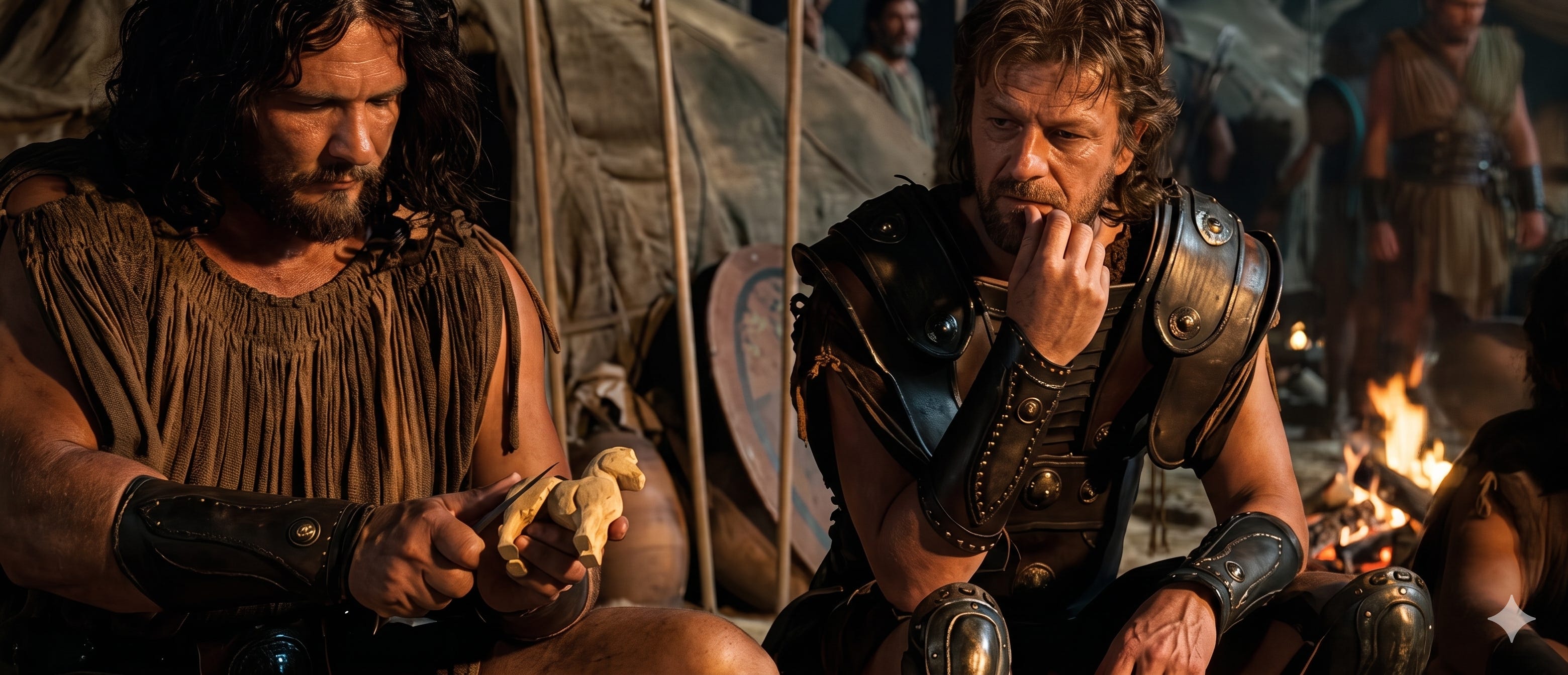
The background. The real war behind the epic took place around 1200 BC, when a coalition of Greek kingdoms (one of which was Sparta) attacked and destroyed Troy – a wealthy, fortified city in modern-day Turkey. The epic tradition placed the mythologised heroes Achilles and Odysseus on the offensive Greek side, crediting Odysseus with the design of the Trojan Horse that ultimately breached the city. A ten-year siege for a city seems extraordinarily long, but Troy occupied an incredibly strategic defensive position. Because Troy was an impregnable coastal fortress with open trade routes, the Greeks couldn’t surround or starve it. For nine years, the conflict was in gridlock, with the Greeks camped on the beaches, raiding nearby towns for supplies, and the Trojans remaining secure behind their formidable walls. This notion of hubris is a strong element picked up by the Troy movie – so much confidence is placed in the city’s ‘unbreachable walls’, which suffer a similar fate to the ‘unsinkable’ Titanic. To maintain momentum, the movie collapses this decade-long war into a span of a few weeks.
Why are the Greeks invading Troy? The mythological reason pertains to Paris, a prince of Troy, visiting Sparta in Greece and taking Helen, the most beautiful woman in the world and wife of the Spartan King Menelaus. The Greek kingdoms united under a massive alliance to sail to Troy, recapture Helen, and restore Greek honour.
The historical reason for the battle. Troy sat in a highly strategic position at the entrance to the Dardanelles, a narrow strait linking the Aegean and Black Seas. The Greek coalition likely attacked Troy to secure control over these lucrative trade routes and access valuable grain, gold, and resources. Archaeological excavations confirm that a wealthy, fortified city at Troy was besieged and destroyed by fire around 1200 BC.
What’s the meaning of the title? The Odyssey is named after its main character, Odysseus. The word ‘odyssey’ has come to mean a long, wandering journey filled with hardships and adventures, reflecting his ten-year struggle to return home after the war. The original title was ‘Odysseia’, which translates to ‘The Story of Odysseus.’ Over the years, Western language adopted the title as a noun.
I’ve read the first few pages. These are the main elements I recall.
Although the Greeks won the war, they were cursed by the gods for committing horrific wartime acts during the sacking of Troy, violating divine law. On the journey back, Odysseus is shipwrecked and marooned on the mythical island of Ogygia. The island is home to the beautiful nymph Calypso, who falls in love with Odysseus and keeps him trapped there, offering immortality if he stays with her forever.
The story opens with a council of the gods on Mt Olympus while Poseidon is away in Ethiopia enjoying a feast. With the sea god distracted, Athena – goddess of wisdom and warfare; daughter of Zeus – pleads Odysseus’ case to Zeus, arguing that he has suffered enough on Calypso’s island. Zeus agrees, and they initiate a plan to bring him home.
“But the heart in me is torn for the sake of wise Odysseus, unhappy man, who still, far from his friends, is suffering griefs, on the sea-washed island.”
Why does Athena care? Athena champions Odysseus because he mirrors her divine nature. As the goddess of wisdom and war strategy, she admires his intellect and resourcefulness. By intervening, she protects her ultimate earthly representative and ensures his legacy survives through his son.
I’m currently at the section in which Athena descends to the house of Odysseus to rouse his passive son Telemachus into action:
“But I shall make my way to Ithaka, so that I may stir up his son a little.”
She flies down to Ithaca disguised as a family friend and merchant, Mentes.
Telemachus is doing nothing as a gang of parasitic, wealthy Greek noblemen have moved themselves into Odysseus’ palace with the aim of forcing Odysseus’ wife, Penelope, into marriage and to claim the vacant throne.
Athena’s arrival as Mentes serves to shock Telemachus out of this passivity, inspiring him to stand up to the suitors.
“Rather I will urge you to consider some means by which you can force the suitors out of your household. Come now, pay close attention to me and do as I tell you.”
Boy must become man:
“You should not go on clinging to your childhood. You are no longer of an age to do that”
“She left in his spirit determination and courage, and he remembered his father even more than he had before, and he guessed the meaning, and his heart was full of wonder, for he thought it was a divinity.”
Interesting side note on the linguistics. In Ancient Greek, the name Mentes shares a root with menos, which means mind, intent, courage. When Athena takes the form of Mentes, she is breathing menos – mental power and courage – into Telemachus to push him into manhood.
This is where I’m at thus far. I’ll keep reading and essaying as I go.
I’ve failed to read it four times so shall I screenshot this
I read Emily Wilson's translation several years ago and thought it was very very good.
The history that surrounds the Dardenelles is mind-boggling isn't it?